

Quick answer: Every Shuddhta honey passes five checks: nothing added, nothing blended, raw processing below 40°C, a named flower or bee and region, and an NMR test for the batch at an independent laboratory. Each check is something you can verify: read the label, ask where it comes from, and ask for the report for your jar's batch number.
| Check | What it means | How you can verify it |
|---|---|---|
| 1. No added sugar | No sugar, syrup, jaggery, flavour or preservative | Ingredients list says only honey |
| 2. No blending | Not mixed with cheaper honey or honey from other regions | Batch NMR report checks origin match |
| 3. Raw | Strained, not heated above 40°C, not pasteurised | Natural crystallisation over time; stated on the product page |
| 4. Named source | Flower or bee, and region, stated for every honey | Each product page and label |
| 5. NMR tested | Every batch tested at an independent third-party laboratory | Ask for the report with your jar's batch number |
Why we set our own standard
"Pure honey" has no fixed meaning on an Indian label, and NMR testing is not required for honey sold in India. In 2020, the Centre for Science and Environment reported that most popular brands it tested failed NMR checks for added syrup (CSE). See which honey brands in India are NMR tested. Our founders started Shuddhta after tasting how much market honey was not real honey, so we decided every claim on our label had to be checkable.
Where our honey comes from
We work with local beekeepers and traditional honey collectors in each region, and every honey names its source:
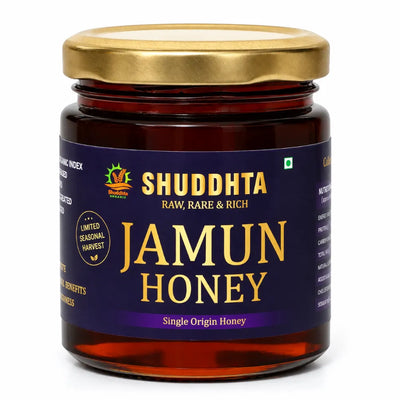
- Single-origin blossom honeys: Litchi (Bihar and West Bengal), Jamun (Maharashtra and Bundelkhand, UP), Tulsi (UP and Madhya Pradesh), Ajwain (Rajasthan and Gujarat)
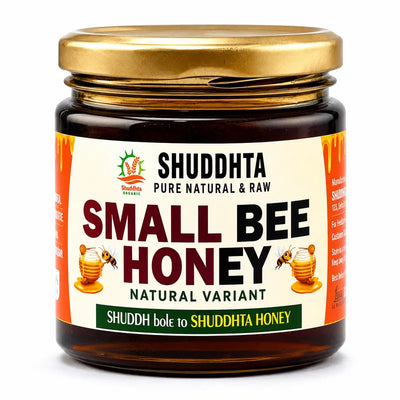
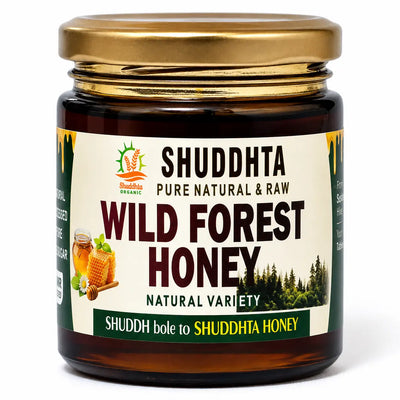
- Multiflora honeys: Small Bee (Bundelkhand), Wild Forest (Bundelkhand and Gujarat), Himachal (Himachal Pradesh)
Single-origin and multiflora are both genuine; they just taste different. See what single-origin honey means.
How the testing works
Before packing, each batch goes to an independent third-party laboratory for NMR (Nuclear Magnetic Resonance) testing. NMR compares the honey's molecular profile with a database of genuine honeys to detect added syrups and origin mismatches. The lab's name and test date are on every batch report. Read how NMR testing works.
Get the report for your jar: send the batch number printed on the jar to help@shuddhta.com or WhatsApp +91 92207 67378.
What our standard does not promise
- Not medicine: honey is a food. We do not make health or cure claims.
- Not sugar-free: "no added sugar" means nothing was added; honey itself is mostly natural sugars.
- Not identical every time: colour, taste and thickness change with flower and season. That is a sign of raw honey, not a defect.
Frequently asked questions
Does every Shuddhta product pass all five checks?
Yes. Single-origin applies to the blossom honeys; Small Bee, Wild Forest and Himachal are multiflora from a named region.
Is raw honey automatically pure?
No. Raw is about processing; pure is about what was added. That is why we test as well. See pure raw honey in India.
Which lab tests Shuddhta honey?
An independent third-party laboratory. Its name and the test date are on the report for each batch.
How do I know a brand really follows its standard?
Ask for specifics: the region, the flower or bee, and a batch report that matches your jar. Vague "100% pure" claims are not enough.
Shuddhta ka shahad pure kaise hai?
Isme kuch mila nahi hota, 40°C se upar garam nahi kiya jaata, har jar par phool ya madhumakkhi aur jagah ka naam hota hai, aur har batch ka NMR test independent lab mein hota hai.
Shop all raw honey → · Compare our 7 honeys
About the author
Pranjal Patel is the founder of Shuddhta Organic and oversees sourcing and batch testing. Read our story.
Sources
Last updated: 9 October 2026.
0 comments