

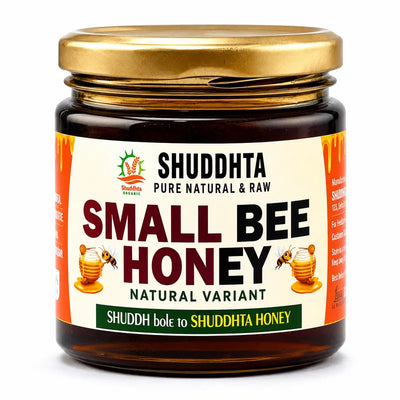
Quick answer: Chhoti Makkhi Ka Shahad, or Small Bee Honey, is honey made by Apis florea, India's native dwarf honey bee. A wild colony makes only about half a kilo of honey a year and cannot be kept in boxes, so the honey is seasonal and limited. Shuddhta's Small Bee Honey is raw multiflora honey from Bundelkhand, hand-collected and cloth-strained, with every batch NMR tested at an independent laboratory.
हिंदी में: छोटी मक्खी का शहद (Small Bee Honey) Apis florea नाम की छोटी देसी मधुमक्खी बनाती है। एक छत्ता साल में लगभग आधा किलो शहद ही देता है, और इस मधुमक्खी को डिब्बों में पाला नहीं जा सकता, इसलिए यह शहद कम और मौसमी मिलता है। शुद्धता का छोटी मक्खी का शहद बुंदेलखंड से आता है, कपड़े से छाना जाता है, गर्म नहीं किया जाता, और हर बैच का NMR टेस्ट एक स्वतंत्र लैब में होता है।
| At a glance | Small Bee Honey (Chhoti Makkhi Ka Shahad) |
|---|---|
| Bee | Apis florea, the dwarf or little honey bee |
| Other names | Chhoti Makkhi Ka Shahad, Choti Makhi ka Shehad, छोटी मक्खी का शहद, Desi Shahad, Little Bee Honey |
| Honey type | Multiflora (bees visit many kinds of flowers) |
| Typical yield | About 0.5 kg per colony per year |
| Can it be farmed in boxes? | No. Colonies build one open comb in the wild and often move. |
| Shuddhta source | Bundelkhand (Uttar Pradesh), from neem, babool, ber and seasonal wild flowers |
| Texture | Smooth, thick and naturally viscous |
| Quality check | Every batch NMR tested by an independent third-party laboratory |
What is Chhoti Makkhi Ka Shahad?
Chhoti Makkhi means "small bee". In India the name refers to Apis florea, the smallest of the native honey bees. It builds a single comb about the size of a palm, out in the open on bushes, hedges and tree branches.
Two things are often confused with it:
- Stingless bee honey comes from a different group of bees altogether. Apis florea is a true honey bee.
- "Desi honey" is a loose market term for any Indian honey. A jar labelled only "desi" is not necessarily Small Bee Honey; look for Apis florea on the label.
The bee: what Apis florea looks like and where it lives
Apis florea is often called the dwarf or little honey bee. It is noticeably smaller than the honey bees used in box beekeeping, and instead of living inside a hive it builds one small, exposed comb, usually wrapped around a twig in a bush or low tree.
It is found across warmer and drier parts of the Indian subcontinent, in open scrub, hedgerows, farm edges and dry forest, which is the kind of landscape Bundelkhand is known for. Because it forages on whatever is flowering nearby, the character of its honey changes with the region and the season.
Small as it is, it matters: native bees like Apis florea are pollinators of wild plants and crops, part of what keeps these landscapes productive.
Why is Small Bee Honey so rare?
The reason is the bee itself. Agricultural references list Apis florea at roughly half a kilo of honey per colony per year, and describe it as a bee that cannot be reared in hives because colonies keep changing location (TNAU Agritech Portal).
- One small open comb per colony, not a box of frames
- Collected only in the flowering season, by hand
- Part of each comb has to be left for the bees, so the take per comb is small
That is why Small Bee Honey costs more than ordinary honey, and why stock runs out between harvests.
How Shuddhta's Small Bee Honey is collected
Our Small Bee Honey comes from Bundelkhand, where most of our beekeeping happens. The landscape is dry forest and rocky scrub, and the bees forage on neem, babool, ber and seasonal wild flowers.
- Finding the comb: local villagers locate wild Apis florea combs during the flowering season.
- Taking only part: they cut away part of the comb and leave the rest for the bees.
- Cloth-straining: the honey is strained through cloth to remove wax and debris. It is not heated or pasteurised.
- Testing: each batch is NMR tested at an independent third-party laboratory before packing.
- Packing: the honey is packed in glass jars, with no added sugar, flavour or preservatives.
What does it taste like?
Shuddhta Small Bee Honey is smooth, thick and naturally viscous, with natural sweetness, a floral aroma and mild earthy notes. Because the bees visit many flowers, colour and flavour change a little from harvest to harvest. That variation is normal for raw multiflora honey and is not a sign of a problem.
Colour, aroma, thickness and how fast it crystallises can all shift with the flowers, the weather and the harvest. Different does not mean fake, and thick does not mean pure either. The way to judge any honey is its source and its lab report, not how it looks.
Small bee vs big bee honey: what is the difference?
In India, "small bee" (chhoti makkhi) usually means Apis florea, and "big bee" (badi makkhi or rock bee) usually means Apis dorsata. Both are wild honey bees that build a single open comb, but the size of the comb and the amount of honey are very different.
| Small bee (Apis florea) | Big bee / rock bee (Apis dorsata) | |
|---|---|---|
| Common name | Chhoti makkhi, little bee, dwarf honey bee | Badi makkhi, rock bee, giant honey bee |
| Comb | One small, palm-sized comb on bushes, hedges and low branches | One very large comb, often on cliffs, tall trees and buildings |
| Honey per comb or colony | About 0.5 kg a year | Much more; TNAU lists about 36 kg per comb a year |
| Can it be kept in boxes? | No | No |
| How the honey is sold | Usually as "small bee" or "chhoti makkhi ka shahad" | Often as "wild", "forest" or "jungle" honey |
Which is better? Neither is better by default. Small bee honey is far scarcer, which is why it costs more. Big bee honey is more widely available. Taste depends on the flowers, not just the bee. For either one, what matters is the same: a named bee and region, no added sugar, and an NMR report for the batch. Source: TNAU Agritech Portal. See all 5 bee species found in India.
Small Bee Honey vs regular honey
| Feature | Small Bee Honey | Regular commercial honey |
|---|---|---|
| Bee | Apis florea (wild) | Usually box-kept bees such as Apis mellifera |
| Colony | One small open comb | Large managed hives |
| Yield | About 0.5 kg per colony per year | Much higher |
| Availability | Seasonal, limited | Year-round, large volumes |
| Collection | By hand from wild combs | Machine extraction from frames |
| Floral source | Multiflora, local wild plants | Single-flower, multiflora or blended |
| Proof of purity | Needs lab testing | Needs lab testing |
Being rare does not make a honey automatically pure. Any honey, small bee or regular, should come with clear sourcing and a lab report.
Small Bee Honey vs stingless bee honey
Both are sold as rare Indian honeys, but they come from very different bees. Apis florea is a true honey bee that builds one open comb. Stingless bees (sold as dammar, putka or cheruthen honey) belong to a separate group, nest in hollows and store honey in small pots. Their honey is usually thinner and more sour. Full comparison: Small Bee vs Stingless Bee (Dammar) Honey.
Small Bee Honey vs sugar
Honey is still a sugar, so it should be eaten in moderation, like any sweetener. The difference is in what you get with the sweetness. Refined sugar is pure sucrose with nothing else. Raw honey is a natural food with its own aroma and flavour that changes with the flowers and season. If you want to swap a spoon of sugar for something less processed, these are easy places to start:
- A spoon in warm (not boiling) water, tea or milk
- Over oats, curd, fruit or toast
- In recipes, using a little less liquid than with sugar
Honey is a food, not a medicine. If you have diabetes or another medical condition, ask your doctor before changing your diet. Never give honey to babies under 12 months old.
How to choose genuine Small Bee Honey
The name "Small Bee Honey" tells you about the bee, but not everything about the jar. Ask four questions:
- Which bee? The label or product page should name Apis florea.
- Where? A real place, not just "jungle" or "desi".
- When? Genuine Small Bee Honey is seasonal and limited. Endless stock at a low price is a warning sign.
- How was it tested and handled? Ask for the NMR report for your jar's batch number, with the lab's name and test date on it. Check that it was strained, not heated.
Ignore home tests: water, flame and thumb tests show how thick a honey is, not whether it contains sugar syrup. See how to identify pure honey: home tests vs what actually works.
Want the NMR report for your Shuddhta jar? Send the batch number on the jar to help@shuddhta.com or WhatsApp +91 92207 67378. Read more in NMR testing explained.
Keep reading: for the other six raw honeys and how they compare, see best raw honey in India: how to choose.
Frequently asked questions
Chhoti Makkhi Ka Shahad kya hai?
Yeh Apis florea naam ki chhoti desi madhumakkhi ka shahad hai. Ek colony saal mein lagbhag aadha kilo shahad banati hai, isliye yeh kam milta hai.
छोटी मक्खी का शहद कहाँ से खरीदें?
असली छोटी मक्खी का शहद खरीदते समय देखें कि लेबल पर Apis florea और जगह का नाम लिखा हो, और ब्रांड आपके जार के बैच की NMR रिपोर्ट दे सके। शुद्धता का छोटी मक्खी का शहद बुंदेलखंड से है और 50 ग्राम, 250 ग्राम, 500 ग्राम और 1 किलो के जार में shuddhta.com पर मिलता है।
Small bee or big bee honey: which is better?
Neither is better by default. Small bee (Apis florea) honey is much scarcer, at about half a kilo per colony a year; big bee (Apis dorsata) combs give far more. Choose by taste, and check the bee, the region and a batch NMR report.
Choti makhi ya badi makhi ka shahad, kaunsa achha hai?
Dono alag hain, ek doosre se behtar nahi. Choti makhi ka shahad bahut kam milta hai, isliye mehenga hai. Badi makhi (rock bee) ka shahad zyada milta hai. Dono mein dekhiye: makkhi aur jagah ka naam, koi added sugar nahi, aur batch ki NMR report.
Is Small Bee Honey the same as stingless bee honey?
No. Apis florea is a honey bee. Stingless bees are a separate group.
Is Small Bee Honey the same as desi honey?
Not necessarily. "Desi honey" is a broad term for Indian honey and can mean any bee or flower. If a jar is sold as Chhoti Makkhi Ka Shahad, it should name the bee as Apis florea and the region it comes from.
Is Small Bee Honey single-origin?
No. It is multiflora, because the bees visit many kinds of flowers. Shuddhta's comes from one region, Bundelkhand.
Why is Small Bee Honey expensive?
A colony yields only about half a kilo a year, the bees cannot be kept in boxes, and the honey is collected by hand in season.
Why is Shuddhta Small Bee Honey thick?
Its natural texture is smooth, thick and viscous. Thickness varies a little by harvest and is not, on its own, a purity test.
Is it heated or processed?
No. It is cloth-strained to remove wax and debris and packed raw, with no added sugar, flavour or preservatives.
Is it NMR tested?
Yes. Every batch is NMR tested at an independent third-party laboratory. You can ask for the report for your batch.
Can it crystallise?
Yes, raw honey can crystallise naturally. Place the closed jar in warm water to soften it. Read why raw honey crystallises.
Which size should I start with?
The 50 GM jar is the easiest way to taste it. It also comes in 250 GM, 500 GM and 1 KG.
Can babies have it?
No. Do not give any honey to infants under 12 months, because of the risk of infant botulism.
Try Shuddhta Small Bee Honey
Buy Small Bee Honey (Chhoti Makkhi Ka Shahad) → Raw multiflora honey from Bundelkhand, in 50 GM, 250 GM, 500 GM and 1 KG jars. Free delivery on orders of ₹499 and above.
Explore more: 5 bee species found in India · Small bee vs stingless bee honey · What is single-origin honey? · NMR tested honey brands in India
About the author
Pranjal Patel is the founder of Shuddhta Organic. He comes from a farming background and oversees sourcing in Bundelkhand, where most of Shuddhta's honey is collected. Read our story.
Sources
Last updated: 20 October 2026. This article is for general information and is not medical advice.
0 comments