

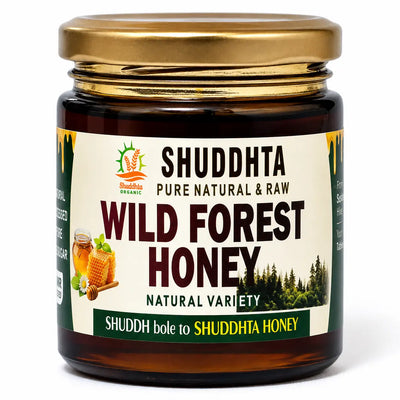
Quick answer: Wild forest honey (jungle ka shahad) is a multiflora honey made from the mix of wild plants that bees find in forest areas, rather than from one crop. Its taste is usually bold, earthy and woody, and its colour and flavour change from batch to batch because the flowers change. Darker does not mean purer. Shuddhta's Wild Forest honey is raw, has no added sugar and is NMR tested batch by batch.
Wild Forest Honey is a distinctive type of multiflora honey associated with diverse forest and wild-flowering environments in India. Unlike single-origin honeys such as Jamun, Litchi, Tulsi or Ajwain, Wild Forest Honey can contain nectar from a changing mix of flowering plants.
This natural floral diversity can give forest honey its own distinctive colour, aroma and flavour from one harvest to another.
What Is Wild Forest Honey?
Wild Forest Honey is generally a multiflora honey associated with forest or other naturally diverse flowering environments.
Instead of being associated predominantly with one cultivated flowering crop, bees may forage across multiple flowering plants available in their surrounding environment.
As a result, the final honey can reflect a combination of different floral sources.
This is what makes Wild Forest Honey different from a single-origin floral honey.
The exact floral composition can vary depending on:
- Location
- Season
- Available vegetation
- Weather
- Flowering patterns
- Bee foraging behaviour
So, natural variation between Wild Forest Honey harvests is expected.
Is Wild Forest Honey Made Only by Wild Bees?
Not necessarily.
The term “Wild Forest Honey” describes the honey’s association with a forest or wild-flowering environment, but it should not automatically be used to identify one particular bee species or production method.
Honey from forest environments may involve different bee populations and collection practices depending on the region.
This is important because:
Bee species, floral source and honey category are three different things.
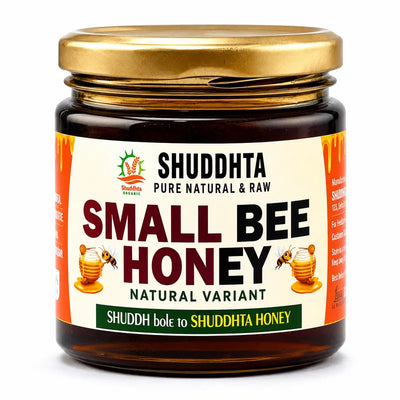
For example, Small Bee Honey is associated with Apis florea, while Wild Forest Honey is primarily a multiflora/floral-environment category.
Learn more about Small Bee Honey and Chhoti Makkhi.
Why Is Wild Forest Honey Multiflora?
A forest ecosystem can contain many different flowering plants.
Bees naturally forage from the flowers that are available around them. When multiple floral sources contribute significantly to the nectar collected, the resulting honey can be considered multiflora honey.
This means Wild Forest Honey does not have one fixed floral profile.
One harvest may differ from another in:
- Colour
- Aroma
- Flavour
- Texture
- Intensity
That natural variation is part of what makes Indian forest honey interesting.
Wild Forest Honey vs Single-Origin Honey
The key difference is the predominant floral source.
| Wild Forest Honey | Single-Origin Honey |
|---|---|
| Generally multiflora | Associated predominantly with one identified floral source |
| Multiple flowering plants may contribute | One botanical source is the defining identity |
| Floral composition can vary by location and season | Closely associated with a particular floral source |
| Character can vary between harvests | Character reflects the predominant floral source |
| Examples: Wild Forest Honey | Examples: Jamun, Litchi, Tulsi, Ajwain |
Neither category is automatically purer or better.
They simply represent different types of honey and different sourcing environments.
What Does Wild Forest Honey Taste Like?
Wild Forest Honey can have a more complex and varied sensory profile because multiple floral sources may contribute to the honey.
Depending on the harvest, you may notice:
- Rich floral notes
- Deeper sweetness
- Earthy or woody nuances
- A more pronounced aroma
- Medium to thick texture
However, there is no single taste profile that applies to every Wild Forest Honey.
Colour, aroma and flavour can naturally vary between batches.
That variation should not automatically be interpreted as a quality problem.
What Colour Is Wild Forest Honey?
Wild Forest Honey can range from golden and amber to darker shades, depending on its floral sources and other production factors.
Darker colour does not automatically mean higher quality or greater purity.
Similarly, lighter honey is not necessarily less authentic.
Colour is a natural characteristic—not a standalone authenticity test.
Is Wild Forest Honey Raw?
Wild Forest Honey can be sold in raw or minimally processed forms, depending on how it is handled after harvesting.
Shuddhta Wild Forest Honey is positioned as raw and unprocessed.
The honey also contains no added sugar, according to Shuddhta’s product positioning.
How Can You Choose Authentic Wild Forest Honey?
When buying Wild Forest Honey in India, don’t rely only on words such as “forest,” “wild” or “natural.”
Instead, look for transparency around:
1. Source
The brand should provide meaningful information about where the honey comes from and the environment associated with the harvest.
2. Floral Character
Because Wild Forest Honey is multiflora, the brand should avoid presenting it as a honey from one specific flower unless there is evidence supporting that claim.
3. Processing
Check whether the honey is described as raw, minimally processed or otherwise processed.
4. Ingredients
Pure honey should not need added sugar or unnecessary flavouring to define its identity.
5. Quality Testing
Laboratory analysis can support honey quality and authenticity assessment.
At Shuddhta Organic, NMR testing is part of our batch-level quality-control and authenticity assessment process.
NMR, or Nuclear Magnetic Resonance, can provide detailed compositional information and can be used as part of a broader approach to assessing honey authenticity and detecting certain adulteration concerns.
Read more:
NMR Testing Explained: Why It Matters for Honey Purity
Is Wild Forest Honey More Pure Than Regular Honey?
Not automatically.
“Wild Forest” describes the honey’s associated environment and multiflora character. It does not, by itself, prove purity.
Likewise, single-origin honey is not automatically purer simply because it comes predominantly from one floral source.
Honey authenticity should be evaluated using a combination of sourcing, traceability, product information and appropriate testing.
For a broader guide, read:
Complete Guide to Pure Honey in India
Why Does Wild Forest Honey Change From Batch to Batch?
Natural multiflora honey can vary because the available flowers change with:
- Season
- Rainfall
- Temperature
- Local vegetation
- Flowering cycles
- Geographic location
Therefore, one Wild Forest Honey harvest may look or taste somewhat different from another.
Natural variation is expected in a multiflora honey.
This is one of the key differences between Wild Forest Honey and a floral honey associated predominantly with one botanical source.
Wild Forest Honey vs Small Bee Honey
Wild Forest names where the bees foraged (a forest, many flowers); Small Bee names which bee made the honey (Apis florea). So they describe different aspects of honey.
Wild Forest Honey generally refers to a multiflora honey associated with forest or diverse wild-flowering environments.
Small Bee Honey / Chhoti Makkhi Ka Shahad refers to honey associated with Apis florea, the Dwarf or Little Honey Bee.
Small Bee Honey can itself be multiflora.
Therefore:
Wild Forest Honey and Small Bee Honey are not interchangeable terms.
Learn more about Chhoti Makkhi Ka Shahad.
Wild Forest Honey vs Other Indian Honeys
India has a wide range of honey varieties, and each represents a different floral or sourcing story.
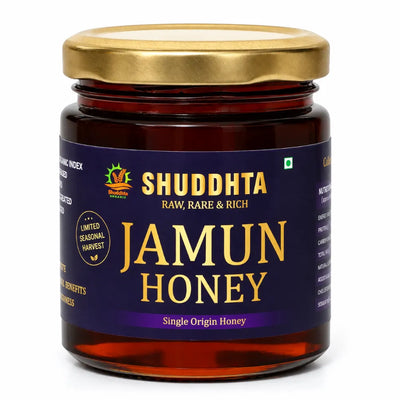
Jamun Blossom Honey
A floral honey associated predominantly with Jamun blossoms.
Litchi Blossom Honey
A seasonal floral honey associated predominantly with litchi blossoms.
Tulsi Blossom Honey
A floral honey associated predominantly with Tulsi blossoms.
Ajwain Blossom Honey
A floral honey associated predominantly with Ajwain blossoms.
Small Bee Honey
Honey associated with Apis florea, commonly known as the Dwarf or Little Honey Bee.
Wild Forest Honey
A multiflora honey associated with forest and diverse wild-flowering environments.
Understanding these distinctions makes it easier to explore India’s diverse honey landscape without confusing bee species, floral origin and honey type.
Frequently Asked Questions
What is Wild Forest Honey?
Wild Forest Honey is generally a multiflora honey associated with forest or diverse wild-flowering environments, where bees can forage from multiple available floral sources.
Is Wild Forest Honey multiflora?
Yes. Wild Forest Honey is generally positioned as a multiflora honey because multiple flowering plants can contribute to its floral composition.
Is Wild Forest Honey single-origin?
Generally, no. Wild Forest Honey is typically multiflora rather than associated predominantly with one specific botanical source.
Is Wild Forest Honey made only by wild bees?
Not necessarily. “Wild Forest Honey” primarily describes the honey’s association with a forest or diverse wild-flowering environment and should not automatically be treated as a specific bee-species designation.
Why does Wild Forest Honey vary in colour?
Its colour can vary because different floral sources, locations, seasons and harvest conditions can contribute to the honey’s natural composition.
Does darker Wild Forest Honey mean it is purer?
No. Honey colour alone cannot establish purity or authenticity.
Is Wild Forest Honey raw?
It depends on how the honey is processed after harvesting. Shuddhta Wild Forest Honey is positioned as raw and unprocessed.
Is Wild Forest Honey good for daily use?
Honey can be used as a food and natural sweetener, depending on individual dietary preferences. It should not be treated as a medicine or a substitute for medical treatment.
Is Shuddhta Wild Forest Honey NMR tested?
Yes. Shuddhta states that its Wild Forest Honey batches are NMR tested as part of its quality-control and authenticity assessment process.
Explore Wild Forest Honey from Shuddhta
If you are looking for Indian Wild Forest Honey, understanding its multiflora nature is important.
Unlike single-origin varieties such as Jamun or Litchi, Wild Forest Honey represents the diversity of multiple floral sources found within its associated environment.
Explore:
You can also explore the Rare Indian Honey Collection and discover different Indian honey varieties based on their floral source, bee association and sourcing environment.
SHUDDH bole to SHUDDHTA HONEY — From Farmer’s Hand to Your Table.
Watch a customer try popular home tests on Shuddhta Organic Wild Forest Honey. Home tests show texture and thickness, not purity; the real check is the batch NMR report, which you can ask us for. 🍯 See what home tests can and can't tell you.
Keep reading: wild forest honey is one of three bold Indian honeys compared in Tulsi, Ajwain & Wild Forest honey. Not sure it suits you? See which honey is best for your routine or the raw honey buying guide.
About the author
Pranjal Patel is the founder of Shuddhta Organic and oversees sourcing and batch testing for its raw honeys. Read our story.
Last updated: 12 October 2026.
0 comments