
Quick answer: Raw honey is honey that has only been strained to remove wax and debris, then packed without heating, pasteurising or ultra-fine filtering. Processed honey is usually heated and finely filtered so it stays clear and runny on the shelf. Heating and filtering change honey: they remove pollen, reduce natural enzymes and raise a heat marker called HMF. Raw honey crystallises more readily, and that is normal. Neither "raw" nor "processed" tells you whether sugar syrup was added; only lab testing such as NMR can show that.
| At a glance | Raw honey | Processed honey |
|---|---|---|
| Heating | Not heated beyond hive-like warmth (Shuddhta: below 40°C) | Often heated to make it flow, slow crystallisation and kill yeasts |
| Filtering | Strained through cloth or mesh | Often fine- or ultra-filtered |
| Pollen | Most natural pollen stays | Much or all of it removed |
| Enzymes (e.g. diastase) | Largely intact | Reduced by heat |
| HMF (heat marker) | Low when fresh | Rises with heating and long storage |
| Look and texture | May be slightly cloudy; crystallises over time | Clear and runny for months |
| Taste | Changes with flower and season | Uniform, often blended |
| Proves no sugar syrup? | No | No |
What is raw honey?
Raw honey is taken from the comb, strained to remove wax, bits of comb and debris, and packed. Nothing is added and it is not heated beyond the warmth honey would see inside a hive. It keeps its natural pollen, enzymes and aroma, which is why raw honey from different flowers tastes so different.
India's food standards define what honey is and set quality limits, but "raw" itself is a marketing word without a separate legal test. So when a label says "raw", ask the brand what it means: at what temperature is the honey handled, and how is it filtered? At Shuddhta, raw means strained only and never heated above 40°C.
What is processed honey?
Most mass-market honey is processed so that it looks the same in every jar and stays liquid on the shelf. Common steps are:
- Heating to make thick honey flow through pipes and filters, dissolve crystals, and slow down re-crystallisation.
- Fine or ultra-filtration under pressure, which removes pollen and fine particles and gives a very clear honey.
- Blending honey from many sources and regions to get a consistent colour and taste.
Processed honey is not automatically fake or unsafe. Heating and filtering are legal. But processing changes what you get, and heavy filtering also removes the pollen that labs use to check where a honey came from.
What heat does to honey
Honey is sensitive to heat. Two measurements show the effect:
- Diastase is a natural enzyme in honey. Heating and long storage reduce its activity.
- HMF (hydroxymethylfurfural) forms when the sugars in honey are heated or stored for a long time. The international Codex standard for honey sets an upper limit for HMF (40 mg/kg in general, 80 mg/kg for honey from tropical climates), because a high value suggests heat damage or old honey.
Heat also drives off some of the volatile compounds that give honey its aroma. That is why a gently handled raw honey usually smells and tastes more of its flower than a heated one.
Why raw honey crystallises (and why that's fine)
Honey holds more sugar than water can normally keep dissolved, so over time glucose forms crystals. Pollen grains and tiny wax particles in raw honey give the crystals a place to start, so raw honey tends to crystallise sooner than heavily filtered honey. Honeys with more glucose, such as ajwain or mustard honey, crystallise fastest.
Crystallised honey is not spoiled. Place the closed jar in warm (not hot) water to soften it, or enjoy it thick on toast. But crystallisation on its own does not prove purity either. More in why raw honey crystallises.
Raw vs pure: not the same thing
This is the most common mix-up.
- Raw is about processing: was it heated or heavily filtered?
- Pure is about what is in the jar: was anything added, such as sugar syrup?
A honey can be raw and still cut with syrup. A honey can be heated and still be pure. In 2020 the Centre for Science and Environment found that most branded honey samples it tested passed India's standard checks but failed NMR testing for added syrup. That is why the most useful thing to ask for is a batch NMR report, not just a "raw" or "pure" label. See NMR testing explained and what "no added sugar" means.
Benefits of raw honey: what's real and what's hype
What is reasonable to say:
- Raw honey keeps more of its natural enzymes, pollen and aroma than heated, ultra-filtered honey.
- Its taste reflects its flower and season, which is half the pleasure of honey.
- Honey has been studied as a soothing option for cough in children over one year old.
What raw honey is not:
- It is not a medicine or a cure for any illness.
- It is not a low-sugar food. Raw or processed, honey is mostly sugar and the WHO counts it as a free sugar. See honey vs jaggery vs sugar.
- It is not safe for babies. Never give any honey, raw or processed, to infants under 12 months.
How to tell if honey is raw
- Read what the brand says about heat and filtering. A specific answer ("strained, never above 40°C") is more useful than "100% natural".
- Look for a named flower or bee and a named region. Raw single-source honey is usually labelled this way, for example Litchi Blossom from Bihar.
- Expect some variation. Raw honey changes in colour and thickness between harvests and may crystallise.
- Don't rely on home tests. Water, flame and thumb tests can't tell raw from processed, or pure from adulterated. See what home tests can and cannot show.
- Ask for the batch NMR report to check for added syrup.
How Shuddhta handles honey
- Strained, not heated: cloth- or mesh-strained, kept below 40°C, never pasteurised.
- Not blended: each jar names its flower or bee and its region.
- No added sugar: nothing added, ever.
- NMR tested: every batch at an independent third-party laboratory. Send your jar's batch number to help@shuddhta.com for the report.
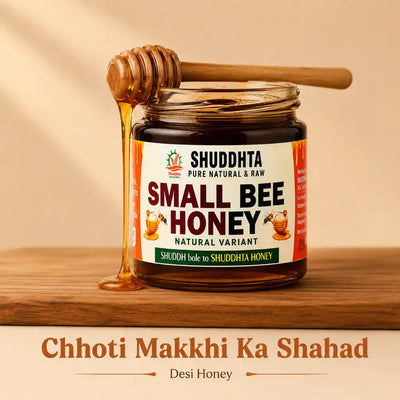
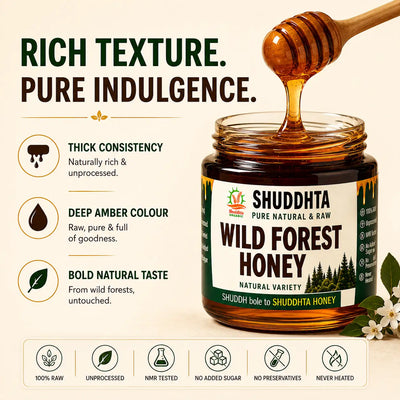
Not sure where to start? Litchi Blossom is the mildest, Wild Forest the boldest, and Small Bee the rarest. Every variety comes in a 50 g jar.
Keep reading: types of honey in India, how to choose the best raw honey in India and what single-origin honey means. Practical next steps: can you put honey in hot water or tea? and how to store honey.
Frequently asked questions
Is raw honey better than processed honey?
Raw honey keeps more of its natural pollen, enzymes and flavour. Whether it is "better" depends on what you want: for taste and character, raw usually wins. Both are still sugar.
Is raw honey safe to eat?
For healthy children over one year and adults, yes. Do not give any honey to infants under 12 months. If you are pregnant or have a medical condition, ask your doctor.
Does raw honey expire?
Honey keeps for a very long time if the jar stays closed and dry. Moisture can make it ferment, so always use a dry spoon.
Why is raw honey more expensive?
It comes from specific flowers and regions in short seasons, isn't blended to stretch supply, and careful handling and testing cost more.
Raw honey aur processed honey mein kya fark hai?
Raw honey sirf chhana jaata hai, garam nahi kiya jaata, isliye uska pollen, enzymes aur khushboo bachi rehti hai. Processed honey ko aksar garam karke bahut baareek filter kiya jaata hai taaki wo saaf aur patla rahe. Milawat ka pata dono mein sirf lab test (NMR) se chalta hai.
Kya jamne wala honey kharab hota hai?
Nahi. Raw honey ka jamna normal hai. Jar ko gungune paani mein rakhein, honey phir se naram ho jayega.
About the author
Pranjal Patel is the founder of Shuddhta Organic and oversees sourcing and batch testing for its raw honeys. Read our story.
Sources
- Codex Alimentarius: Standard for Honey (CXS 12-1981), including HMF and diastase criteria
- Centre for Science and Environment: honey adulteration investigation (2020)
- Cochrane review: honey for acute cough in children
- World Health Organization: Guideline on sugars intake (2015)
Last updated: 12 October 2026. Honey is a food, not a medicine.
0 comments