

Quick answer: The best honey depends on how you use it. For a mild everyday or first honey, choose Litchi or Himachal. For a warm herbal taste in tea, choose Tulsi. For bold flavour after meals, choose Ajwain. For a deep, earthy honey in oats or around training, choose Wild Forest or Jamun. For something rare, choose Small Bee. All seven Shuddhta honeys are raw, have no added sugar and are NMR tested. None of them is a medicine.
Not everyone chooses honey for the same reason. A gym-goer may want a convenient carbohydrate source around training, while a runner or cyclist may be interested in honey as part of an endurance-fuelling routine. Others may prefer Small Bee Honey, Ajwain Honey, Tulsi Honey, Pahadi honey or a mild floral honey for everyday use.
Which honey variant is best for you?
It depends on your lifestyle. Jamun, Litchi and Wild Forest Honey can fit active lifestyles; Jamun, Small Bee and Wild Forest suit strength-training routines; Tulsi and Small Bee fit traditional throat-comfort routines; Ajwain suits traditional digestive routines; Himachal is ideal for Pahadi honey preferences; and Litchi is a good choice for people who prefer mild floral honey.
Important: these are lifestyle-based recommendations, not claims that one honey medically treats a condition or is universally superior to another.
Find Your Honey
What are you looking for? Choose the honey that best matches your taste, routine or preference.
| Your lifestyle or preference | Honey to explore |
|---|---|
| 🏋️ Gym and fitness | Jamun / Litchi / Wild Forest |
| 💪 Powerlifting and strength training | Jamun / Small Bee / Wild Forest |
| 🏃 Running | Jamun / Litchi / Wild Forest |
| 🚴 Cycling | Jamun / Litchi / Wild Forest |
| 😮💨 Traditional throat comfort | Tulsi / Small Bee |
| 🍽️ Traditional digestive routine | Ajwain |
| 🥄 Traditional churan routine | Small Bee |
| ⚖️ Weight-conscious choices | Jamun, but honey still contains sugars |
| 🐝 Rare Indian honey | Small Bee |
| 🌲 Wild and multifloral honey | Wild Forest |
| 🏔️ Pahadi or Himalayan honey | Himachal |
| 🌸 Mild floral honey | Litchi |
Why does the honey variant matter?
Honey is not a completely uniform food. Its flavour, aroma and composition can vary with floral source, geographical origin, season and environmental factors. A single-origin or blossom honey can have a different identity from a multiflora honey collected from several floral sources.
Choose by what matters most to you: fitness, taste, origin, traditional use, rarity or everyday breakfast use.
Which honey is best for gym and fitness?
Honey is primarily a carbohydrate-containing food, so Jamun, Litchi and Wild Forest Honey can fit an active lifestyle. Human research has examined honey as a carbohydrate source around exercise, but honey should not be presented as a performance-enhancing supplement.
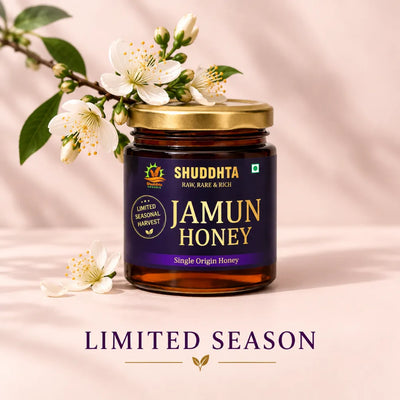
Jamun Honey has a distinctive carbohydrate profile that makes it interesting to specialty-honey consumers. Litchi Honey suits people who prefer a lighter floral taste, while Wild Forest Honey offers a broader multifloral character.
Explore Jamun Blossom Honey, Litchi Blossom Honey or Wild Forest Honey.
Which honey is best for powerlifting and strength training?
For powerlifting, Jamun, Small Bee and Wild Forest Honey can be considered as carbohydrate-containing foods around a balanced strength-training diet. Honey does not replace protein and is not a muscle-building supplement.
Choose Jamun for a specialty honey profile, Small Bee for a rare traditional Indian honey experience, or Wild Forest for a wild multifloral character.
Which honey is best for running and cycling?
Jamun, Litchi and Wild Forest Honey can be explored as food-based carbohydrate options around running or cycling. Individual tolerance matters, so any new honey-based fuelling strategy should be tested during training rather than for the first time on race day.
Honey can be part of an appropriate endurance diet, but there is not enough evidence to claim that one honey variety universally improves running or cycling performance.
Which honey is best for cough or seasonal throat comfort?
The evidence relates primarily to honey itself as a possible option for symptomatic relief of acute cough in children over 12 months. See the Cochrane review of honey for acute cough in children. This does not prove that one floral honey is medically superior to another.
Tulsi Blossom Honey and Small Bee Honey can be selected for their traditional identity and seasonal wellness routines. They should not be marketed as cures for cough, infection or cold, and should not replace medical advice.
Never give honey to children under 12 months. See the CDC guidance on botulism and honey.
Which honey is best for a traditional digestive routine?
If you enjoy an Ajwain-associated traditional food routine, Ajwain Blossom Honey is the natural fit. It should not be presented as a treatment for acidity, gas, IBS, constipation, ulcers or digestive disease.
Which honey is best with churan?
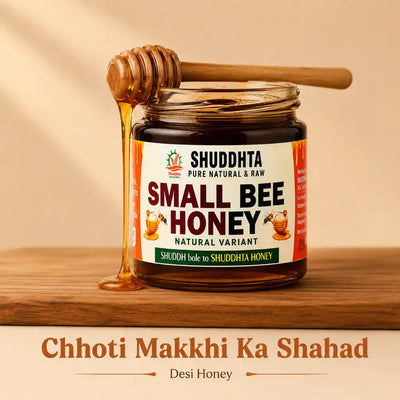
For a traditional food-use pairing, Small Bee Honey, also known as Chhoti Makkhi Ka Shahad, is the natural Shuddhta choice. This is a traditional-use recommendation, not evidence that it increases the medicinal effect of churan.
Which honey is best for daily use and a mild floral taste?
Litchi Blossom Honey is a good choice for first-time buyers and people who prefer a light, delicate, mildly fruity floral profile. It can fit breakfast foods such as oats, yoghurt, toast and smoothies.
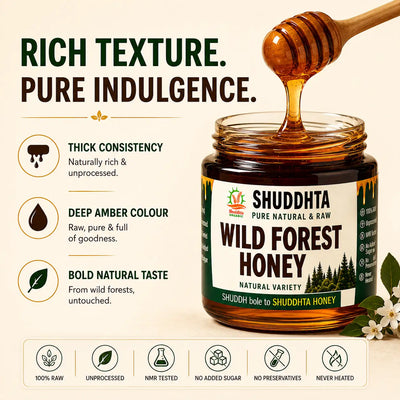
Himachal Honey suits people looking for Pahadi or Himalayan multifloral honey, while Wild Forest Honey suits people who enjoy a broader wild-floral profile.
Which honey is best if you want rare Indian honey?
Small Bee Honey, or Chhoti Makkhi Ka Shahad, is a distinctive choice for consumers interested in a lesser-known Indian honey variety associated with the small honey bee. Choose it for rarity, traditional identity and a different Indian honey experience.
What is the difference between monofloral and multifloral honey?
A monofloral honey is associated predominantly with nectar from a particular plant source, while a multifloral honey comes from multiple floral sources. This can affect flavour, aroma, colour, composition and seasonal character.
Jamun, Litchi, Ajwain and Tulsi are presented as blossom or floral honeys. Wild Forest and Himachal are positioned as multifloral choices. Product-level floral identity and labelling should be supported by appropriate sourcing and testing. See FSSAI food-safety regulations for the applicable Indian standards and rules.
Keep reading: to understand the varieties in more depth, read how to choose raw honey in India, what ajwain honey tastes like and how to consume honey: best time and methods.
Frequently Asked Questions About Choosing Honey
Is Jamun Honey good for weight loss?
No honey should be considered a weight-loss treatment. Jamun may interest people who prefer its distinctive sugar profile, but it still contains sugars and contributes energy.
Which honey should I take with medicine?
There is no universal recommendation. Follow the medicine's instructions and ask a doctor or pharmacist if you are unsure whether honey can be consumed with a particular medication.
Which honey is best for daily use?
Litchi suits mild-floral preferences, Himachal suits Pahadi or multifloral preferences, Wild Forest suits wild-floral preferences and Small Bee suits consumers looking for a rare traditional honey.
Can babies eat honey?
No. Honey should not be given to children younger than 12 months because of the risk of infant botulism.
What should I check when choosing honey?
Consider the source, floral identity, testing, transparency and labelling rather than relying only on broad marketing claims.
Sources and further reading
- PubMed: research on honey and exercise
- Cochrane: honey for acute cough in children
- CDC: botulism prevention and honey safety
- FSSAI: food-safety standards and regulations
Final answer: Which honey is right for you?
There is no single honey that is best for everyone. Choose Jamun, Litchi or Wild Forest for an active lifestyle; Jamun, Small Bee or Wild Forest for a strength-training routine; Tulsi or Small Bee for traditional throat-comfort positioning; Ajwain for a traditional digestive routine; Small Bee for rarity; Himachal for Pahadi honey; and Litchi for a mild floral taste.
Choose by your lifestyle. Choose by your taste. Choose your honey.
Shuddhta Organic
Purani Parampara, Nayi Soch.
About the author
Pranjal Patel is the founder of Shuddhta Organic and oversees sourcing and batch testing for its raw honeys. Read our story.
Last updated: 12 October 2026.
0 comments