

Quick answer: NMR (Nuclear Magnetic Resonance) testing is not mandatory for honey sold in India. In the best-known public NMR check of Indian brands, the Centre for Science and Environment (CSE) study released in December 2020, only three of 13 brands passed all tests: Saffola, Markfed Sohna and Nature's Nectar (one of its two samples). Those results describe the batches tested in 2020, so the most reliable way to choose NMR tested honey today is to ask the brand for a recent, batch-specific NMR report.
Searches like "NMR tested honey brands in India" and "which honey brands passed the NMR test" have grown since that study. This guide explains what NMR testing is, what the 2020 results actually showed, why an "NMR tested" badge on its own is not proof, and how to check a brand's claim before you buy.
What Is NMR Testing for Honey?
NMR (Nuclear Magnetic Resonance) spectroscopy reads the molecular "fingerprint" of a honey sample. A laboratory compares that fingerprint with a database of authentic honeys to look for signs that do not belong there, such as sugar syrups or a profile that does not match the claimed origin.
It matters because some modern syrups, made from rice or beet, are designed to pass older tests. The standard C3/C4 sugar test can detect cane and corn syrups, but these newer syrups can slip through it. NMR can pick up many of these patterns, which is why it is widely used for honey authenticity work around the world.
For a deeper explanation of how the test works, read NMR Testing Explained: Why It's the Gold Standard for Honey Purity.
Is NMR Testing Mandatory in India?
For honey sold in India: no. FSSAI's honey standards rely on other parameters and tests. When the CSE study came out, FSSAI's scientific panel said NMR was "not necessary at this juncture". It pointed to the lack of an Indian honey reference database, the high cost of the equipment and the specialist skills needed to run it.
For honey exported from India: yes. According to CSE's 2020 report, NMR testing became mandatory for honey exports from 1 August 2020.
In practice, a jar of honey on an Indian shelf does not have to be NMR tested. Some brands choose to do it, and that is why the claim is worth checking.
Which Honey Brands Passed the NMR Test in India? (CSE Study, 2020)
In 2020, CSE bought 22 samples from 13 honey brands sold in India. Most samples passed the Indian standard tests run at a laboratory in India. When the same brands were sent to a laboratory in Germany for NMR testing, most of them failed. CSE reported that 77% of the samples were adulterated with sugar syrup, and only 5 of the 22 samples passed all tests.
| Brand | Result in the CSE 2020 study |
|---|---|
| Saffola (Marico) | Passed all tests |
| Markfed Sohna | Passed all tests |
| Nature's Nectar | One of two samples passed |
| Dabur | Did not pass NMR (Dabur disputed this, citing its own NMR reports) |
| Patanjali | Did not pass NMR |
| Baidyanath | Did not pass NMR |
| Zandu (Emami) | Did not pass NMR |
| Hitkari | Did not pass NMR |
| Apis Himalaya | Did not pass NMR |
Read this table carefully. It reports one study of specific samples bought in 2020. It does not tell you how any brand's honey tests today. Several brands disputed the findings, and recipes, suppliers and testing practices can change over time. Treat it as a reason to ask questions, not as a permanent ranking.
Why an "NMR Tested" Badge Isn't Enough
"NMR tested" is now a popular label claim. On its own, a badge does not tell you:
- Which batch was tested. One good batch says nothing about the jar in your hand.
- When it was tested. A report from years ago may not cover current harvests.
- Which laboratory ran the test, and whether it is an independent lab.
- What was checked. A report should show the sugar-syrup markers and authenticity results, not just a single "pass" stamp.
How to Check if a Honey Brand Is Really NMR Tested: 5 Steps
1. Ask for the batch report
Ask the brand for the NMR report that covers the batch you are buying. A brand that tests every batch should be able to share it.
2. Match the batch number
The batch or lot number on the report should match the one printed on your jar.
3. Check the lab name and date
Look for the testing laboratory's name and a recent test date. Be careful with reports that have no lab name, no date or no batch details.
4. Look at what the report covers
A useful report shows the authenticity results, such as foreign sugar or syrup markers. A bare certificate with only a logo tells you very little.
5. Check the basics too
Make sure the label shows an FSSAI licence number, lists only honey as the ingredient, and does not include added sugar or syrup. An FSSAI licence is a legal requirement for selling food. It does not mean the honey was NMR tested.
Can Home Tests Replace NMR?
No. Water, flame, thumb and tissue tests show how a honey behaves physically. They cannot detect engineered sugar syrups. For a fuller explanation, read Is Your Honey Really Pure? 7 Home Tests and What They Really Show and our guide to the best honey in India.
How Shuddhta Tests Its Honey
At Shuddhta Organic, every batch of honey is tested by NMR (Nuclear Magnetic Resonance) analysis at an independent third-party laboratory before it is packed. The laboratory's name and the test date are shown on each batch report. Our honey is raw, has no added sugar, artificial flavours or preservatives, and each variety comes from a stated floral or regional source. Our FSSAI licence number is 22725285000125.
Want to see the NMR report for your jar? Send us the batch number printed on your jar at help@shuddhta.com or on WhatsApp (+91 92207 67378), and we will share the NMR report for that batch.
Explore our NMR tested honeys:
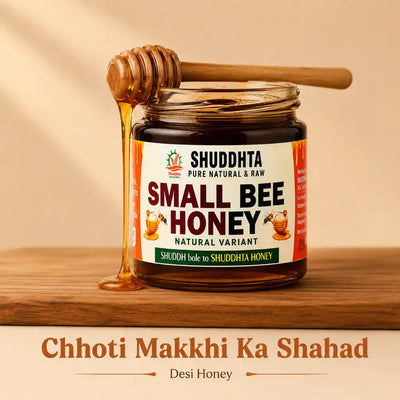
- Small Bee Honey (Chhoti Makkhi ka Shahad) from Bundelkhand
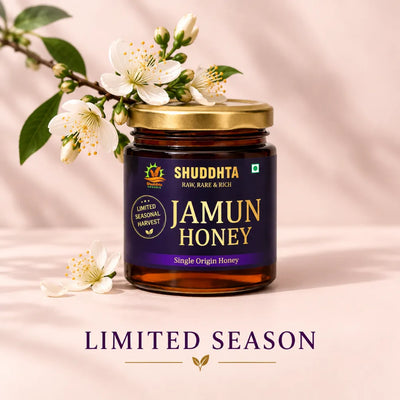
- Jamun Blossom Honey from Maharashtra and Bundelkhand (Uttar Pradesh)
- Wild Forest Honey from Bundelkhand and Gujarat
- Litchi Blossom Honey from Bihar and West Bengal
- All Shuddhta honeys
Frequently Asked Questions
Which honey brands are NMR tested in India?
There is no official public list. In the CSE study of 2020, Saffola and Markfed Sohna passed all tests and Nature's Nectar passed with one of its two samples. Since then, several brands, including Shuddhta, say they NMR test their honey. Ask any brand for a recent, batch-specific report to confirm.
Can I get the NMR report for my Shuddhta honey?
Yes. Send the batch number printed on your jar to help@shuddhta.com or on WhatsApp at +91 92207 67378, and we will share the NMR report for that batch.
Is NMR testing mandatory for honey in India?
Not for honey sold within India. According to CSE's 2020 report, it has been mandatory for honey exports since 1 August 2020.
Does an FSSAI licence mean honey is NMR tested?
No. An FSSAI licence is required to sell food in India. NMR testing is a separate, voluntary step for honey sold in India.
Can NMR detect every kind of honey adulteration?
No single test is perfect. NMR is a powerful screening method, but its results depend on the reference database the laboratory uses. It works best alongside clear sourcing, traceability and other quality checks.
Is NMR tested honey the same as raw honey?
No. NMR tests authenticity. "Raw" describes how honey is processed, meaning it is not heavily heated or filtered. A honey can be one without the other. Shuddhta honey is both raw and NMR tested.
Sources
- Centre for Science and Environment: Food Fraud (honey investigation, 2020)
- Business Today: Only Saffola, Markfed Sohna, Nature's Nectar among 13 brands pass, claims CSE (Dec 2020)
- Nuffoods Spectrum: FSSAI views NMR unnecessary for testing honey (Dec 2020)
- The Tribune: CSE investigation on honey adulteration (Dec 2020)
This article summarises publicly reported findings for general information. Results of past studies may not reflect any brand's current products.

0 comments