

Quick answer: Single-origin (monofloral) honey is honey made mainly from the nectar of one kind of flower, such as jamun, litchi, tulsi or ajwain, harvested in one region during that flower's season. Multiflora honey comes from many flowers at once, as in wild forest or Himalayan honey. "Single-origin" means one flower is predominant, not that every drop came from it. It also isn't proof of purity on its own: look for the named flower, the region, and a batch NMR report.
You've heard of single-origin coffee and single malt whisky. But what about single-origin honey?
Honey can have a surprisingly strong connection to the flowers from which bees collect nectar. Different floral sources can contribute different aromas, colours, flavours and natural characteristics to honey.
So, what exactly does single-origin honey mean, how is it different from multiflora honey, and how can you choose authentic single-origin honey in India?
Let's explore.
What Is Single-Origin Honey?
Single-origin honey is honey produced from nectar collected predominantly from one identified floral source or botanical origin.
Unlike multiflora honey, where bees may forage from many flowering plants, a single-origin honey is associated primarily with one dominant floral source during a particular flowering period and geographical region.
For example:
- Litchi Blossom Honey → predominantly associated with litchi blossoms
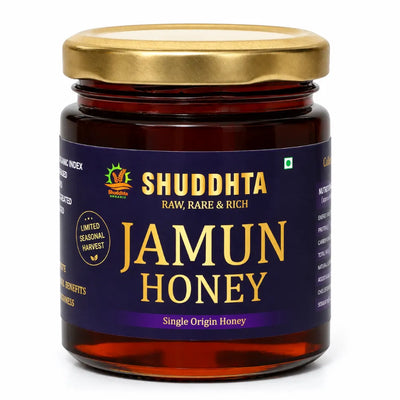
- Jamun Blossom Honey → predominantly associated with Jamun blossoms
- Tulsi Blossom Honey → predominantly associated with Tulsi flowers
- Ajwain Blossom Honey → predominantly associated with Ajwain blossoms
The exact floral composition can naturally vary depending on local flowering conditions, bee foraging behaviour, weather and surrounding vegetation.
That's why “single-origin” does not necessarily mean that every drop of nectar came from only one flower species. It means the honey is associated predominantly with the claimed floral source.
How Is Single-Origin Honey Produced?
Producing a floral-specific honey requires careful attention to flowering seasons, location, hive placement and bee foraging conditions.
When a particular crop or plant is flowering, beekeepers may place managed bee colonies near that floral source. During the flowering period, bees collect nectar and pollen from the available flowers.
If the target floral source is sufficiently dominant, the resulting honey can be harvested and represented according to that botanical origin.
This makes season and geography important parts of single-origin honey production in India.
For instance, litchi blossom honey is associated with litchi-growing regions during the litchi flowering season, while Jamun Blossom Honey is associated with the flowering period of the Jamun tree.
Why Does Single-Origin Honey Taste Different?
One of the most interesting things about floral honey is that the floral source can influence its sensory character.
The natural nectar composition and volatile compounds associated with different flowers can contribute to differences in honey's:
- Colour
- Aroma
- Flavour
- Sweetness perception
- Texture
- Crystallisation behaviour
This is why two genuine honeys can taste completely different even when both are simply honey.
Examples of Indian Single-Origin Honey
Litchi Blossom Honey
Often lighter in colour with a delicate, floral character and mild fruity notes.
Tulsi Blossom Honey
Can have a distinctive herbal and aromatic character associated with Tulsi blossoms.
Ajwain Blossom Honey
Known for a more pronounced, aromatic profile associated with Ajwain flowering.
Jamun Blossom Honey
Often darker in colour with a distinctive, deeper flavour profile associated with Jamun blossoms.
Natural variation is expected. Colour or taste alone cannot prove a honey's botanical origin or purity.
Single-Origin Honey vs Multiflora Honey
The simplest difference is the dominant floral source.
| Single-Origin Honey | Multiflora Honey |
|---|---|
| Associated predominantly with one identified floral source | Nectar may come from multiple flowering plants |
| Distinctive floral character | Often reflects a combination of floral sources |
| Usually linked to a particular flowering season | Can be produced across varied flowering conditions |
| Botanical origin is an important part of its identity | Floral diversity is part of its identity |
| Examples: Jamun, Litchi, Tulsi, Ajwain | Examples: Wild Forest, Himachal and other multiflora honeys |
Neither category automatically means better quality. They are simply different types of honey with different floral identities.
Is Single-Origin Honey More Pure?
Not automatically.
“Single-origin” describes the predominant botanical source of a honey. It does not, by itself, prove that the honey is pure, unadulterated or superior to multiflora honey.
Authenticity depends on several factors, including:
- Responsible sourcing
- Traceability
- Appropriate testing
- Accurate product representation
- Quality-control practices
- Transparent information about origin
This distinction is important when choosing authentic honey in India.
How Can You Verify Authentic Single-Origin Honey?
Check four things: a named floral source, the region and season of harvest, traceability back to that harvest, and a laboratory test such as NMR for the batch.
A label saying “Jamun Honey” or “Litchi Honey” is not, by itself, enough to establish botanical authenticity.
For a more reliable assessment, look for brands that provide clear information about:
1. Floral Source
The brand should clearly state the claimed botanical source rather than using vague terms such as simply “natural honey.”
2. Geographical and Seasonal Context
Information about where and when the honey is harvested can make the product's origin more transparent.
3. Traceability
A transparent sourcing process helps connect the finished honey with its production and harvest information.
4. Laboratory Testing
Advanced analytical methods such as NMR (Nuclear Magnetic Resonance) profiling can be used as part of honey authenticity and quality-control programs.
NMR analysis can help identify compositional patterns and screen for certain forms of adulteration and authenticity concerns. However, no single test should be presented as an absolute guarantee of every aspect of honey authenticity.
At Shuddhta Organic, NMR testing is part of our approach to quality control and authenticity assessment.
Learn more about the technology in our guide to NMR Testing Explained: Why It Matters for Honey Purity.
Why Is Single-Origin Honey Seasonal?
The availability of single-origin honey is closely connected to the flowering season of its source plant.
A floral honey can only be associated with a particular botanical source when that plant is flowering and providing nectar.
This is one reason why varieties such as Jamun Blossom Honey and Litchi Blossom Honey may have more limited seasonal availability compared with general multiflora honey.
Seasonality can also influence:
- Harvest timing
- Availability
- Taste
- Colour
- Aroma
- Batch characteristics
So, natural variation between harvests is not necessarily a sign of inconsistency.
Which Single-Origin Honey Should You Try?
There is no single “best” single-origin honey for everyone. Your choice can depend on the floral character and taste profile you prefer.
🍯 Litchi Blossom Honey
A good choice if you prefer a lighter, delicate floral honey with a mild fruity character.
🍯 Jamun Blossom Honey
A distinctive choice for those interested in darker, deeper Indian floral honeys.
🍯 Tulsi Blossom Honey
Aromatic and herbal in character, making it an interesting floral variety to explore.
🍯 Ajwain Blossom Honey
A more pronounced floral honey with a characteristic aromatic profile.
Explore our collection of Indian single-origin honeys and discover how different floral sources can create different honey experiences.
Single-Origin Honey in India: Why It Matters
India has an incredibly diverse range of flowering plants, agricultural regions and ecological environments.
This creates the potential for a wide variety of Indian floral honeys, from orchard and plantation blossoms to native flowering plants.
Understanding the floral source helps consumers move beyond simply asking:
“Is this honey pure?”
and start asking:
“Where did this honey come from, and what flowers contributed to it?”
That is the real value of knowing a honey's origin.
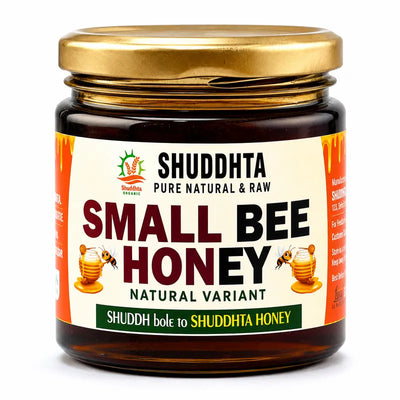
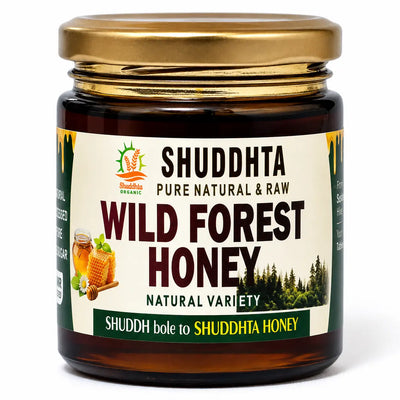
Single-Origin Honey vs Small Bee Honey vs Wild Forest Honey
These are three different labels: single-origin names the flower, Small Bee names the bee, and Wild Forest names the landscape. They describe different aspects of honey and should not be confused.
Single-Origin Honey refers primarily to the predominant floral/botanical source.
Small Bee Honey / Chhoti Makkhi Ka Shahad refers to honey associated with Apis florea, the Dwarf or Little Honey Bee. It can be multiflora rather than single-origin.
Wild Forest Honey generally refers to honey collected from diverse forest or wild-flowering environments and is typically multiflora rather than tied to one botanical source.
So:
Bee species, floral source and honey category are not the same thing.
This distinction is especially important when exploring India's diverse honey varieties.
How Single-Origin Honey Fits Into the Shuddhta Range
At Shuddhta Organic, our single-origin collection focuses on distinctive Indian floral sources, including:
- Jamun Blossom Honey
- Litchi Blossom Honey
- Tulsi Blossom Honey
- Ajwain Blossom Honey
Other Shuddhta varieties, such as Small Bee Honey, Wild Forest Honey and Himachal Honey, are positioned separately as multiflora honeys.
This allows each honey to be represented according to its actual floral and sourcing identity rather than putting every variety into the same category.
Frequently Asked Questions
What is single-origin honey?
Single-origin honey is honey associated predominantly with one identified floral or botanical source, usually within a particular region and flowering season.
Is single-origin honey better than multiflora honey?
Not necessarily. Single-origin and multiflora honey are different categories. Single-origin honey highlights a dominant floral source, while multiflora honey represents nectar collected from multiple flowering plants.
Is Jamun Honey single-origin?
Jamun Honey can be represented as a single-origin or floral-origin honey when Jamun is the predominant identified floral source and the product is appropriately sourced and represented.
Is Litchi Honey single-origin?
Litchi Blossom Honey can be considered single-origin when litchi is the predominant floral source and the honey meets the appropriate sourcing and authenticity criteria.
Does single-origin honey mean 100% one flower?
Not necessarily. Bees naturally forage, and surrounding flowers can contribute to the nectar collected. “Single-origin” generally refers to a predominant identified floral source, rather than literally every drop originating from one flower species.
Can NMR prove single-origin honey?
NMR profiling can be a valuable analytical tool for assessing honey composition and authenticity, including comparison with botanical-origin profiles and screening for certain adulteration patterns. It should not be described as an absolute standalone proof of every aspect of honey authenticity.
Does single-origin honey crystallise?
Yes. Single-origin honey can crystallise naturally. Crystallisation depends on factors including sugar composition, floral source, temperature and storage conditions. Crystallisation by itself is neither proof of purity nor proof of adulteration.
Learn more: Why Raw Honey Crystallises.
Single origin honey ka matlab kya hai?
Single origin honey woh shahad hai jo mukhya roop se ek hi phool ke ras se bana ho, jaise jamun, litchi ya tulsi, ek hi ilaake aur mausam mein.
Multiflora honey kya hota hai?
Multiflora honey mein makkhiyan kai tarah ke phoolon ka ras laati hain, jaise jungle ya pahadon ka shahad. Yeh single origin se "kam" nahi hai, bas alag hai.
Explore Authentic Indian Honey
Understanding honey starts with understanding its origin.
From Jamun Blossom Honey and Litchi Blossom Honey to Tulsi and Ajwain, India's floral diversity creates an exciting range of honey varieties with their own natural characteristics.
If you're looking for single-origin honey in India, focus on the floral source, sourcing information, seasonality, traceability and appropriate quality testing—not just the words printed on the label.
Explore more about Pure Honey in India and the Best Raw Honey in India.
SHUDDH bole to SHUDDHTA HONEY — From Farmer's Hand to Your Table.
0 comments