

Quick answer: India has hundreds of bee species, but honey mainly comes from five kinds of bees, four of them desi bees native to India. The Indian honey bee is Apis cerana indica, the native bee kept in boxes. The others are the rock bee (Apis dorsata), the little bee or chhoti makkhi (Apis florea), stingless bees (such as Tetragonula iridipennis) and the imported European bee (Apis mellifera), which most commercial honey in India comes from.
| Common name (Hindi) | Scientific name | Native? | Kept in boxes? | Honey |
|---|---|---|---|---|
| Indian honey bee (desi makkhi) | Apis cerana indica | Yes | Yes | Moderate yield, varies by flower |
| Rock bee / giant bee (badi makkhi) | Apis dorsata | Yes | No: open combs on cliffs and trees | High yield per comb, often sold as wild/forest honey |
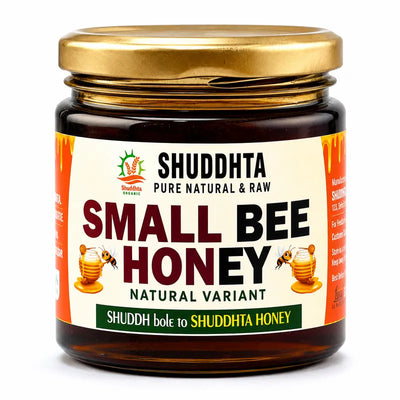
| Little bee (chhoti makkhi) | Apis florea | Yes | No: small open comb | About 0.5 kg per colony a year, rare: Small Bee Honey |
| Stingless bee (dammar / putka) | Tetragonula iridipennis and others | Yes | Yes, in small boxes or logs | Very small yield, thinner and more sour |
| European / Italian bee | Apis mellifera | No (introduced) | Yes | Highest yield, most commercial honey |
India is home to several honey bee species, each with different nesting habits, colony characteristics, foraging behaviour and honey production patterns.
Understanding the bee species behind honey can help you better understand Indian honey, Small Bee Honey, Chhoti Makkhi Ka Shahad, Wild Forest Honey and other traditional honey varieties.
But one important point comes first: bee species and honey type are not always the same thing. The floral source, geography and season also influence the characteristics of honey.
Here are five important honey bee species found in India and what makes each one different.
1. Apis cerana indica — The Indian Honey Bee
Scientific name: Apis cerana indica
Common name: Indian honey bee
Found in: Different parts of India, including Himalayan regions, northeastern India and other suitable habitats
Honey production: Varies according to colony, forage, climate and management
Apis cerana indica is an important native Indian honey bee and has long been associated with traditional and managed beekeeping in India.
Unlike wild open-comb species such as Apis dorsata and Apis florea, Apis cerana can be kept in suitable managed hives.
The honey produced by Apis cerana can vary considerably depending on the flowers available to the bees.
This means that the bee species alone does not determine whether honey is single-origin or multiflora. Floral source, location and season also matter.
What honey can Apis cerana produce?
Depending on the region and available flowers, Apis cerana colonies can produce honey from different floral sources.
For example, honey from Himalayan or other Indian regions may have different colour, aroma, flavour and texture depending on the plants visited by the bees.
2. Apis dorsata — The Giant Honey Bee
Scientific name: Apis dorsata
Common names: Giant honey bee, rock bee
Found in: Various forested and suitable regions of India
Nesting: Large open combs on trees, cliffs and other exposed locations
Apis dorsata is one of India's large native honey bee species.
It typically builds large open combs rather than living inside conventional hive boxes. Because of its nesting behaviour and defensive nature, it is not generally managed in the same way as common hive bees.
Apis dorsata is also associated with traditional honey harvesting in several parts of India.
Is Wild Forest Honey made only by Apis dorsata?
Not necessarily.
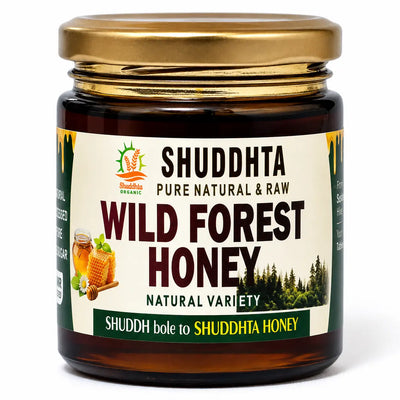
Apis dorsata often contributes to wild honey, but the name “Wild Forest Honey” describes where the bees foraged, not which bee made it.
Wild Forest Honey is generally a multiflora honey category, meaning bees may collect nectar from many different flowering plants.
Apis dorsata can contribute to wild honey harvesting, but you should not automatically assume that every Wild Forest Honey comes exclusively from Apis dorsata.
The bee species, floral source and harvesting region all need to be considered.
You can learn more about this in our Wild Forest Honey Complete Guide.
3. Apis florea — The Dwarf or Little Honey Bee
Scientific name: Apis florea
Common names: Dwarf honey bee, Little honey bee, Chhoti Makkhi
Found in: Suitable parts of India, particularly warmer plains and other suitable habitats
Nesting: Small open combs
Apis florea is commonly known as the Dwarf Honey Bee or Little Honey Bee.
In India, it is also associated with the familiar term Chhoti Makkhi, which means “small bee.”
Apis florea builds small open combs and produces relatively limited quantities of honey compared with several larger managed honey bee species.
This limited production is one reason why honey associated with Apis florea is less commonly available commercially.
What is Chhoti Makkhi Ka Shahad?
Chhoti Makkhi Ka Shahad, also known as Small Bee Honey, refers to honey associated with Apis florea.
Depending on where the bees forage, this honey can be multiflora, with nectar collected from several flowering plants.
It should not automatically be classified as single-origin simply because it comes from one bee species.
Is Apis florea a stingless bee?
No.
Apis florea is a honey bee species commonly known as the Dwarf or Little Honey Bee.
Stingless bees are a separate group of bees and should not be used as a synonym for Apis florea or Small Bee Honey.
This distinction is particularly important when researching Chhoti Makkhi Ka Shahad, Small Bee Honey and Desi Honey.
For a detailed explanation, read our Chhoti Makkhi Ka Shahad: small bee vs big bee honey.
4. Stingless Bees — A Separate Group of Honey-Producing Bees
Common description: Stingless bees
Distribution: Found in various tropical and subtropical parts of India
Nesting: Colonies typically live in protected cavities or sheltered locations
Honey: Can have a distinctive flavour and higher moisture content depending on species and conditions
Stingless bees are not the same as Apis florea.
They belong to a different group of social bees and are known for their very small body size and reduced sting apparatus.
Some stingless bee species produce small quantities of honey, and stingless bee honey is traditionally valued in certain regions.
However, the terms Stingless Bee Honey, Small Bee Honey and Chhoti Makkhi Ka Shahad should not be treated as interchangeable terms.
Small Bee vs Stingless Bee
Apis florea (the small bee, or chhoti makkhi) and stingless bees are different bees, so Small Bee Honey and Stingless Bee Honey are different products:
| Feature | Apis florea | Stingless Bees |
|---|---|---|
| Common description | Dwarf/Little Honey Bee | Stingless bee |
| Indian term | Chhoti Makkhi | Regional names vary |
| Bee group | Apis | Different stingless-bee group |
| Honey production | Relatively limited | Generally limited |
| Honey identity | Small Bee Honey / Chhoti Makkhi Ka Shahad | Stingless Bee Honey |
| Same species? | No | No |
This distinction helps avoid one of the most common misconceptions about traditional Indian honey.
5. Apis mellifera — The Western or European Honey Bee
Scientific name: Apis mellifera
Common name: Western honey bee / European honey bee
Found in: Managed beekeeping operations across many parts of India
Nesting: Usually kept in managed hive boxes
Apis mellifera is an introduced honey bee species that is widely used for commercial beekeeping.
It is valued by beekeepers because colonies can produce substantial quantities of honey under suitable management and forage conditions.
Apis mellifera honey can come from many different floral sources.
For example, depending on the location and season, managed colonies may forage on crops such as mustard, eucalyptus, sunflower and other flowering plants.
Therefore, Apis mellifera honey is not automatically a single type of honey.
The final honey characteristics depend heavily on the available floral source, harvesting conditions and processing.
Does the Bee Species Determine Honey Quality?
Not by itself.
Whether honey is pure depends on how it was sourced and handled and whether anything was added, not on which bee made it.
The bee species is one part of the story, but honey characteristics can also depend on:
- Floral source
- Geographical region
- Season
- Bee species
- Harvesting practices
- Processing and storage
- Moisture and natural composition
For example, two honeys produced by the same bee species can have very different characteristics if the bees forage on different flowers.
Likewise, honey from different bee species can share similar floral characteristics if the bees forage in the same landscape.
So, bee species alone should not be used as a measure of honey purity or quality.
Bee Species vs Honey Type: What's the Difference?
Bee species tells you which bee made the honey; honey type tells you its flower, region or production context. Every honey has both.
Bee Species
This tells you which bee produced the honey.
Examples:
- Apis cerana indica
- Apis dorsata
- Apis florea
- Apis mellifera
- Stingless bees
Honey Type
This usually describes the floral source, geography or production context.
Examples:
- Jamun Blossom Honey
- Litchi Blossom Honey
- Tulsi Blossom Honey
- Ajwain Blossom Honey
- Wild Forest Honey
- Small Bee Honey
- Himachal Honey
Therefore:
Bee species ≠ floral source ≠ honey type
All three provide different information about a honey.
Where Does Small Bee Honey Fit?
For Shuddhta's honey classification, Small Bee Honey is associated with Apis florea and is positioned as a multiflora honey.
The bees may forage across multiple flowering plants, so it should not be presented as a single-origin honey merely because the bee species is specific.
This gives us a clearer structure:
Apis florea
↓
Dwarf / Little Honey Bee
↓
Chhoti Makkhi
↓
Small Bee Honey
↓
Multiflora
And separately:
Stingless Bees
↓
Stingless Bee Honey
These are different bee/honey relationships.
What About Desi Honey?
“Desi Honey” is a broad informal term and should not automatically be treated as another name for Apis florea honey.
In India, “desi honey” may be used in different contexts to describe locally sourced, traditionally produced or Indian honey.
If a product is specifically sold as Chhoti Makkhi Ka Shahad / Small Bee Honey, the more useful question is:
Which bee species is it associated with?
For genuine Small Bee Honey, the relevant species is Apis florea.
For any honey, however, the word “desi” alone does not prove its bee species, floral source or authenticity.
How Can You Choose Authentic Indian Honey?
Whether you are buying Small Bee Honey, Wild Forest Honey or a single-origin floral honey, don't rely on one visual or kitchen test.
Instead, look for:
1. Clear source information
The brand should provide meaningful information about where the honey comes from.
2. Floral information
If the honey is described as single-origin or multiflora, the product information should explain what that classification means.
3. Bee information where relevant
For specialty honey such as Small Bee Honey, knowing the associated bee species adds useful context.
4. Testing and quality control
Appropriate laboratory testing can provide analytical information about honey composition and authenticity.
Read our NMR Testing Explained guide to understand how NMR-based analysis can be used in honey quality-control and authenticity assessment.
5. Transparent labeling
Look beyond marketing terms such as “pure,” “natural,” “desi” or “wild.” Consider the complete product information.
For a broader buying framework, read our Best Raw Honey in India guide.
Keep reading: small bee honey vs stingless bee honey and types of honey in India by flower, bee and processing.
Frequently Asked Questions
Which bee produces Chhoti Makkhi Ka Shahad?
Chhoti Makkhi Ka Shahad, or Small Bee Honey, is associated with Apis florea, commonly called the Dwarf or Little Honey Bee.
Is Apis florea a stingless bee?
No. Apis florea is a honey bee species. Stingless bees belong to a separate group.
Is Small Bee Honey the same as Stingless Bee Honey?
No. Small Bee Honey associated with Apis florea and Stingless Bee Honey come from different bee groups and should not be treated as synonyms.
Is Small Bee Honey single-origin?
Not necessarily. Small Bee Honey can be multiflora when Apis florea bees forage across several flowering plants.
Is Desi Honey the same as Small Bee Honey?
Not necessarily. “Desi Honey” is a broad informal term, while Small Bee Honey specifically refers to honey associated with Apis florea.
Is Wild Forest Honey always made by Apis dorsata?
No. Wild Forest Honey can involve different bees and multiple floral sources. Bee species should not be assumed from the term “forest honey” alone.
Does the bee species determine whether honey is pure?
No. Bee species is only one part of honey identity. Authenticity depends on sourcing, handling, composition and appropriate testing.
Which honey bee is used commercially in India?
Apis mellifera and Apis cerana are both used in managed beekeeping in India. The exact bee species and honey produced depend on the beekeeping system, region and available forage.
Final Thoughts
India's honey diversity is closely connected to its diverse bee species, flowering plants, landscapes and traditional harvesting practices.
From Apis cerana and Apis mellifera in managed beekeeping to Apis dorsata and Apis florea in more open-comb environments, different bees contribute to India's diverse honey landscape.
For Small Bee Honey, the key relationship is especially clear:
Apis florea → Dwarf/Little Honey Bee → Chhoti Makkhi → Small Bee Honey
And importantly:
Apis florea is not a stingless bee.
When choosing Indian honey, look beyond labels such as “desi,” “wild,” “pure” or “natural.” Consider the bee species where relevant, floral source, region, season, processing, traceability and appropriate quality testing.
For a deeper look at Small Bee Honey, explore our Chhoti Makkhi Ka Shahad guide.
0 comments