
Quick answer: Indian honey can be grouped four ways: by the flower the nectar came from (single-flower honeys like jamun, litchi, mustard and eucalyptus, or multiflora honeys like forest and Himalayan honey), by the bee that made it (five main bees, from the tiny Apis florea to the giant rock bee), by processing (raw or processed) and by form (liquid, crystallised or comb). Most honey in a supermarket is blended multiflora honey from box-kept bees. Specialty honeys name their flower, their bee and their region.
| Way to group honey | Main types in India |
|---|---|
| By flower | Single-flower (monofloral): mustard, eucalyptus, litchi, jamun, sunflower, karanj, acacia, tulsi, ajwain, orange blossom. Multiflora: wild forest, Himalayan, mixed-flower. |
| By bee | Apis mellifera (European bee), Apis cerana (Indian hive bee), Apis dorsata (rock bee), Apis florea (little bee), stingless bees |
| By processing | Raw (strained only) or processed (heated, finely filtered, often blended) |
| By form | Liquid, crystallised or creamed, comb honey |
Types of honey by flower
The flower a bee visits shapes a honey's colour, taste and texture more than anything else. A honey is called single-flower (monofloral or single-origin) when one plant is its main nectar source, and multiflora when many plants contribute. Neither is better; they are different. Read what single-origin honey means.
Common single-flower honeys in India
| Honey | Where it's typically produced | Character |
|---|---|---|
| Mustard (rapeseed) | North India's mustard belt (Punjab, Haryana, Rajasthan, UP) | Pale, mild; crystallises very fast into a creamy white set |
| Eucalyptus | Plantations in several states, including the Nilgiris | Medium amber, slightly medicinal aroma |
| Litchi (lychee) | Bihar (Muzaffarpur) and West Bengal | Light, fruity, floral; a favourite first raw honey |
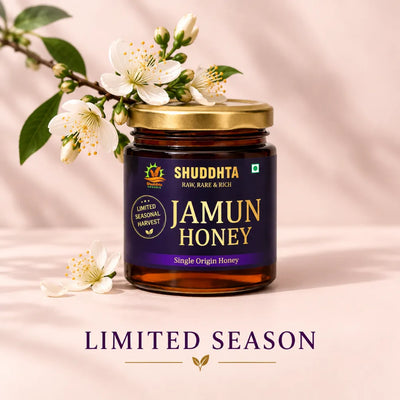
| Jamun | Forested and orchard areas, e.g. Maharashtra, Bundelkhand | Dark, bold, slightly tangy; short season |
| Sunflower | Sunflower-growing regions of the south and centre | Golden; crystallises quickly |
| Karanj (pongamia) | Central and eastern India | Medium amber, distinct floral note |
| Acacia | Kashmir and the north | Very pale, mild; stays liquid for a long time |
| Tulsi | UP and Madhya Pradesh | Warm, herbal-floral |
| Ajwain | Rajasthan and Gujarat | Dark, aromatic, slightly spicy; crystallises fast |
| Orange blossom | Meghalaya and other citrus areas | Light, citrusy aroma |
"Jamun honey" or "litchi honey" should mean honey from those flowers, not honey with flavour added. Check that the label names the flower as the source and that the brand can tell you the region and season. See real vs flavoured jamun honey.
Multiflora honeys
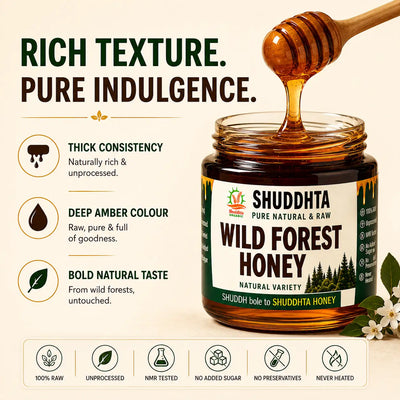
- Wild forest honey comes from forests and scrub where bees visit many wild plants. It is usually darker and bolder, and changes with the season. See the wild forest honey guide.
- Himalayan or pahadi honey comes from hill flowers in states like Himachal Pradesh and Uttarakhand. It is often clean-tasting and mild. See the Himachal honey guide.
- General multiflora honey is the everyday supermarket type, usually blended from many sources.
Types of honey by bee
India has five main kinds of honey-making bee. The bee affects how much honey a colony makes, how it is collected and how rare the honey is. Full details in 5 bee species found in India.
| Bee | Common name | How it lives | Honey |
|---|---|---|---|
| Apis mellifera | European or Italian bee | Kept in boxes; the main commercial bee | Most of the honey sold in India |
| Apis cerana indica | Indian hive bee | Kept in boxes or wild in cavities | Traditional village honey |
| Apis dorsata | Rock bee, giant bee (badi makkhi) | Wild; one huge comb on cliffs, tall trees and buildings | Much of the "wild" or "jungle" honey collected in India |
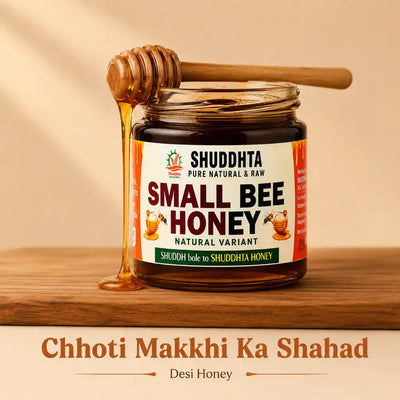
| Apis florea | Little bee, dwarf bee (chhoti makkhi) | Wild; one small, palm-sized comb on bushes | Small bee honey: about half a kilo per colony a year, so it's rare |
| Stingless bees (e.g. Tetragonula) | Dammar or cheruthen bee | Small colonies in tree hollows and walls | Thin, sweet-sour honey in tiny quantities |
Small bee honey and stingless bee honey are often confused. Apis florea is a true honey bee; stingless bees are a separate group. See small bee vs big bee honey.
Types of honey by processing
- Raw honey is only strained, not heated or ultra-filtered. It keeps its pollen and aroma and may crystallise.
- Processed honey is usually heated and finely filtered so it stays clear and runny, and is often blended.
Neither label proves the honey is free of added syrup; that needs a lab test such as NMR. Full comparison in raw honey vs processed honey.
Types of honey by form
- Liquid honey is how most honey is sold.
- Crystallised or creamed honey is honey whose glucose has formed crystals, naturally or under control. It is not spoiled. See why raw honey crystallises.
- Comb honey is honey sold still in the wax comb.
Which type of honey should you choose?
| If you want… | Try |
|---|---|
| A mild honey for tea or first-timers | Litchi Blossom or Himachal Multiflora |
| A bold, dark honey | Wild Forest or Jamun Blossom |
| A herbal, warming taste for winter | Tulsi Blossom or Ajwain Blossom |
| Something rare | Small Bee (Chhoti Makkhi Ka Shahad) |
Whatever type you choose, check four things: a named flower or bee, a named region, a harvest season, and a batch NMR report. The full checklist is in how to choose the best raw honey in India.
Keep reading: which honey suits your routine, honey vs jaggery vs sugar and NMR testing explained. Also see small bee vs stingless bee honey, why rare honey costs more and how to buy real honey online.
Frequently asked questions
How many types of honey are there in India?
There is no fixed number. India produces dozens of single-flower honeys depending on region and season, plus many multiflora honeys, from five main kinds of bee.
Which is the rarest honey in India?
Honeys from bees that make very little, such as small bee (Apis florea) and stingless bee honey, and single-flower honeys with a short season, such as jamun, are among the scarcest.
Which honey is most common in India?
Blended multiflora honey and mustard honey from box-kept Apis mellifera colonies make up a large share of what is sold.
Is multiflora honey worse than single-flower honey?
No. They are different, not better or worse. What matters is that the source is stated honestly and the honey is free of added syrup.
Bharat mein shahad kitne prakar ke hote hain?
Shahad ko phool (jaise jamun, litchi, sarson, tulsi), makkhi (badi makkhi, chhoti makkhi, desi makkhi), processing (raw ya processed) aur roop (patla, jamaa hua, chhatte wala) ke hisaab se baanta jaata hai.
Chhoti makkhi aur badi makkhi ke shahad mein kya fark hai?
Chhoti makkhi (Apis florea) bahut kam shahad banati hai, isliye uska shahad durlabh hai. Badi makkhi (rock bee) ka chhatta bada hota hai aur shahad zyada milta hai.
About the author
Pranjal Patel is the founder of Shuddhta Organic and oversees sourcing and batch testing for its raw honeys. Read our story.
Sources
- TNAU Agritech Portal: types of honey bees
- AgroSpectrum: India's monofloral honey varieties
- APEDA: Natural honey (India)
Last updated: 12 October 2026.
0 comments