

Quick answer: In India, everyday branded multiflora honey usually sells for about ₹200–₹450 per kg online, while raw single-origin and rare honeys typically cost ₹1,000–₹2,500 per kg. The difference comes from the bee and flower (some colonies make very little honey), the length of the season, whether the honey is blended to stretch supply, and whether each batch is tested. To compare fairly, work out the price per 100 g and check what you're actually getting.
| Type of honey | Typical price per kg (online, India) | Why |
|---|---|---|
| Mass-market blended multiflora | About ₹200–₹450 | Large volumes, blended from many sources, often processed |
| Raw multiflora with a named region | About ₹800–₹1,200 | Smaller batches, not blended, careful handling |
| Raw single-flower (litchi, tulsi, ajwain, jamun) | About ₹1,000–₹1,600 | Short flowering season, one main source |
| Rare honey (small bee, stingless bee) | About ₹1,500 and up | Tiny yields per colony, hand collection |
Ranges are indicative, based on prices seen online in October 2026. Prices vary with offers, pack size and season.
Why does some honey cost ₹200 a kilo and some ₹1,800?
1. The bee
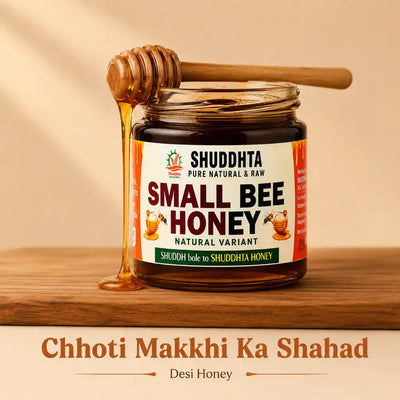
Box-kept European bees (Apis mellifera) can produce a lot of honey per hive, which keeps everyday honey cheap. Wild bees are a different story. A small bee (Apis florea) colony makes only about half a kilo of honey a year, so Small Bee honey is scarce by nature. See types of honey in India.
2. The flower and the season
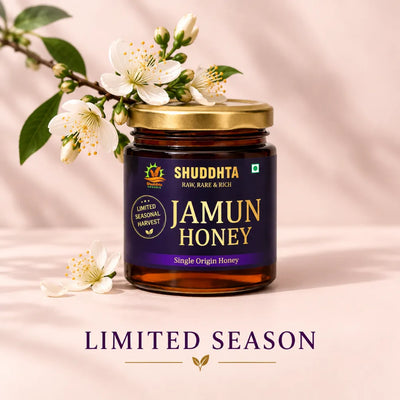
Single-flower honeys come from short bloom windows. Litchi flowers for a few weeks; jamun honey has a short season too. Less time to harvest means less honey and a higher price.
3. Blending versus single-source
Blending honey from many places evens out colour and taste and keeps prices low. Single-source honey isn't blended, so each batch is smaller and costs more to handle.
4. Processing
Heating and fine filtering make large-scale packing faster. Raw honey, strained and handled below about 40°C, is slower to pack. See raw vs processed honey.
5. Testing
Batch NMR testing at an independent lab adds cost. It also gives you evidence that the honey hasn't been cut with sugar syrup.
6. Adulteration economics
Sugar syrup is far cheaper than honey. In 2020, the Centre for Science and Environment reported that most branded honey samples it tested failed NMR checks for added syrup, which shows how much price pressure there is. A price far below others for the same type of honey is worth questioning. See what the 2020 NMR tests found.
How to compare honey prices fairly
- Use price per 100 g. Divide the price by the weight in grams and multiply by 100. A ₹299 jar of 250 g is about ₹120 per 100 g.
- Compare like with like. A single-flower raw honey shouldn't be judged against blended supermarket honey.
- Check what's included. Free delivery thresholds, shipping charges and offers change the real price.
- Be wary of rare honey at everyday prices. Endless stock of a rare honey at a low price is a red flag.
Is expensive honey always better?
No. Price reflects scarcity and handling, not proof of purity. An expensive honey still needs a named source and a batch report. A good everyday multiflora honey can be excellent value. Use the checklist in how to buy real honey online.
What Shuddhta honey costs
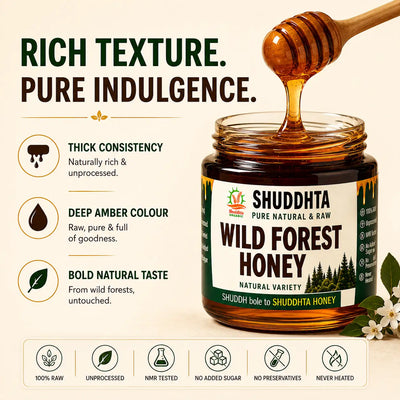
Shuddhta honeys are raw, single-source and NMR tested batch by batch. Most varieties come in 50 g, 250 g, 500 g and 1 kg jars, and 1 kg jars range from about ₹849 to ₹1,599 depending on the honey. See current prices for all seven honeys. Delivery is free on orders of ₹499 and above. Buying for others? See the honey gift guide.
Keep reading: how to choose the best raw honey in India and how to buy real honey online.
Frequently asked questions
What is the price of pure honey per kg in India?
Everyday branded honey is often about ₹200–₹450 per kg online. Raw single-origin honey usually costs ₹1,000 or more per kg.
Why is raw honey so expensive?
Short seasons, small batches, no blending, careful handling and batch testing all add cost.
Is cheap honey fake?
Not necessarily. Some everyday honey is genuine but blended and processed. Price alone can't tell you; a batch NMR report can.
Shahad ka rate 1 kg kitna hota hai?
Aam branded shahad lagbhag ₹200–₹450 prati kilo milta hai. Raw, ek phool ya durlabh shahad ₹1,000 se zyada ka hota hai, kyunki uski matra kam hoti hai aur use mix nahi kiya jaata.
About the author
Pranjal Patel is the founder of Shuddhta Organic and oversees sourcing and batch testing for its raw honeys. Read our story.
Sources
- Centre for Science and Environment: honey adulteration investigation (2020)
- TNAU Agritech Portal: honey bee types and yields
Last updated: 12 October 2026. Prices change; the checkout shows current prices.
0 comments