
Quick answer: To buy real honey online in India, check seven things before you pay: the ingredient list says only "honey"; the label names the flower or bee; it names the region and season; the brand can send a batch NMR report with the lab's name and date; the seller shows an address and FSSAI licence; there's a clear policy for damaged jars; and the price per 100 g makes sense for the type of honey. A honey that can't pass these checks may still be fine, but you have no way of knowing.
| Check | What good looks like | Red flag |
|---|---|---|
| 1. Ingredients | "Honey" only | Sugar, syrup, jaggery, flavour, "honey blend" |
| 2. Flower or bee | "Litchi blossom", "Small bee (Apis florea)" | Only "pure", "natural" or "organic" |
| 3. Region and season | "Bihar, March–April harvest" | "Forest" or "Himalayan" with no place |
| 4. Batch NMR report | Lab name, test date, batch number matching your jar | "NMR tested" badge with no report |
| 5. Seller details | Address, phone, FSSAI licence number | No way to contact the brand |
| 6. Damage and returns | A written policy and time window | No policy, or one that contradicts itself |
| 7. Price per 100 g | Fits the honey type (rare honey costs more) | Rare honey at mass-market prices |
1. Read the ingredient list
Real honey has one ingredient: honey. Anything else (sugar, glucose, rice or corn syrup, jaggery, flavouring) means it's a honey product, not honey. On a marketplace, open the product images and zoom in on the back label, not just the title.
2. Look for a named flower or bee
"Pure honey" tells you nothing about the source. Good labels say what the bees fed on (litchi, jamun, tulsi, mustard) or which bee made it (for example small bee, Apis florea). Multiflora honey is fine too, as long as the region is named. See types of honey in India.
3. Check the region and season
Single-flower honeys come from short flowering windows, so a brand that really sources them knows where and when. Litchi honey from Bihar, or multiflora honey from the hills of Himachal, are specific. Read how Himalayan multiflora honey differs from forest honey.
4. Ask for the batch NMR report
This is the most important check. In 2020, the Centre for Science and Environment found that most branded honey samples it tested passed India's standard checks but failed NMR testing for added sugar syrup. Home tests can't catch modern syrups either.
A useful report shows the lab's name, the test date and a batch number that matches the one printed on your jar. A single old certificate used for every product is much weaker evidence. More in what an NMR report should show and why home tests don't prove purity.
5. Check who is selling it
Every food business in India needs an FSSAI licence or registration, and the number should be on the label and the website. Also look for a physical address and a working phone or email. On a marketplace, check whether the seller is the brand itself or a reseller.
6. Read the damage and return policy
Glass jars can break in transit. A good seller tells you how quickly to report damage and what you'll get: a replacement or a refund. Note that opened food usually can't be returned for change of mind.
7. Compare price per 100 g
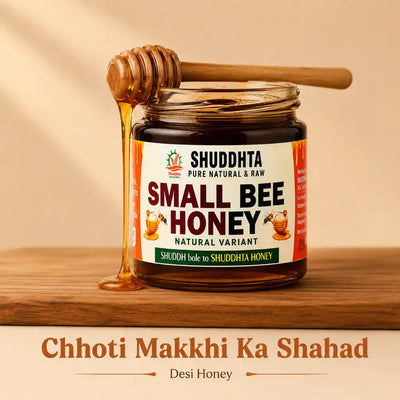
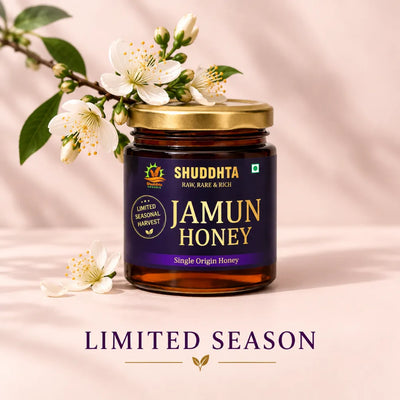
Divide the price by the weight and compare like with like. Mass-market multiflora honey is cheap because it is produced and blended at scale. Rare honeys, such as small bee or single-season jamun honey, are scarce, so a very low price for them is a warning sign. Full breakdown in honey price per kg in India.
Brand website or marketplace?
- On a marketplace: buy from the brand's own store listing if there is one. Read recent reviews that mention taste and texture, not just delivery. Zoom in on the back label in the photos.
- On a brand website: look for the FSSAI number, policies, contact details and a way to request the batch report. Check that the shipping and refund pages agree with each other.
Online asli shahad kaise kharidein (Hinglish)
- Label par sirf "honey" likha ho, cheeni ya syrup nahi.
- Phool ya makkhi ka naam ho (jaise litchi, jamun, chhoti makkhi).
- Jagah aur season ka naam ho.
- Brand aapke jar ke batch ki NMR report de sake.
- FSSAI number, address aur return policy saaf likhi ho.
How Shuddhta meets the checklist
- Ingredients: honey only, no added sugar.
- Source: every jar names its flower or bee and its region. Browse all seven raw Indian honeys.
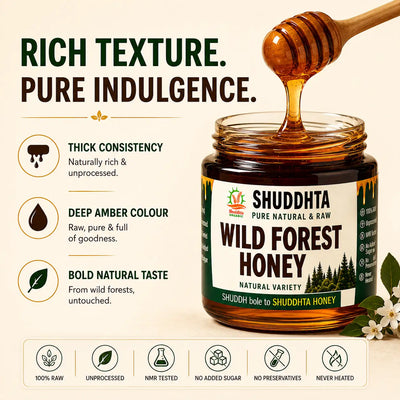
- Testing: every batch NMR tested at an independent laboratory. Send the batch number on your jar to help@shuddhta.com for the report.
- Seller: FSSAI licence no. 22725285000125, with our address and phone on the contact page.
- Policies: damaged or wrong jars reported within 24 hours of delivery are replaced or refunded. See our refund policy and shipping policy.
Buying for someone else? See the Diwali honey gift guide.
Keep reading: best raw honey in India: how to choose, raw vs processed honey and how to store honey once it arrives.
Frequently asked questions
Is it safe to buy honey online in India?
Yes, if you check the label, the seller and the testing. The risk isn't buying online. It's buying honey with no named source and no batch report.
How can I tell if honey bought online is real?
You can't tell by looking, tasting or doing home tests. Ask for the batch NMR report and check that the batch number matches your jar.
Why does my online honey look different from the photo?
Raw honey changes colour and thickness between harvests and may crystallise in cool weather. That's natural. See why raw honey crystallises.
What if the jar arrives broken?
Photograph it and contact the seller straight away. Most sellers, including us, set a short reporting window.
About the author
Pranjal Patel is the founder of Shuddhta Organic and oversees sourcing and batch testing for its raw honeys. Read our story.
Sources
- Centre for Science and Environment: honey adulteration investigation (2020)
- Food Safety and Standards Authority of India (FSSAI)
Last updated: 12 October 2026.
0 comments